Quickteller - Rebuilt From the Ground Up
Quickteller Travel
Quickteller - Rebuilt From the Ground Up
Quickteller
Quickteller — Rebuilt From the Ground Up
Quickteller — Rebuilt From the Ground Up
Project overview
Project overview
Designers: Femisola Fatogun (Lead), Ridwan Oladimeji, Tomi Joshua
Designers: Femisola Fatogun, Ridwan Oladimeji, Tomi Joshua
What I worked on
What I worked on
Design Direction
Product Direction

Quickteller Had Outgrown Itself
Quickteller Had Outgrown Itself

A decade of growth will do that.
More features. More platforms. More weight.
Years before I joined, the business decided: start over.
Three Ideas. Thirty People. One Answer.
Three Ideas. Thirty People. One Answer.

Research pointed to three distinct directions. Surveys couldn't pick a winner — respondents couldn't evaluate what they couldn't experience.
Research pointed to three distinct directions. Surveys couldn't pick a winner — respondents couldn't evaluate what they couldn't experience.

Thirty participants. Six days. Remote and in-person.
Thirty participants. Six days. Remote and in-person.

The Superapp won by 96.7%.
That was the direction I inherited, not the one I built.
The Superapp won by 96.7%.
That was the direction I inherited, not the one I built.
Joining Mid-Flight
Joining Mid-Flight
I stepped in shortly after, taking over from Etse, the designer who led that early work.
Ridwan Oladimeji and Tomi Joshua who were on the team earlier, continued with me in this next chapter.
Three designers. Six PMs. Three platforms. One system to hold together.
I stepped in shortly after, taking over from Etse, the designer who led that early work.
Ridwan Oladimeji and Tomi Joshua who were on the team earlier, continued with me in this next chapter.
Three designers. Six PMs. Three platforms. One system to hold together.
Building for What Comes Next
Building for What Comes Next

By the time I arrived, Quickteller was straining again.
Every quarter. More sub-products. More places to look.
Someone had flagged it before. The business hadn't acted.
It was brought up, and then we reached a consensus on fixing this problem with the business.
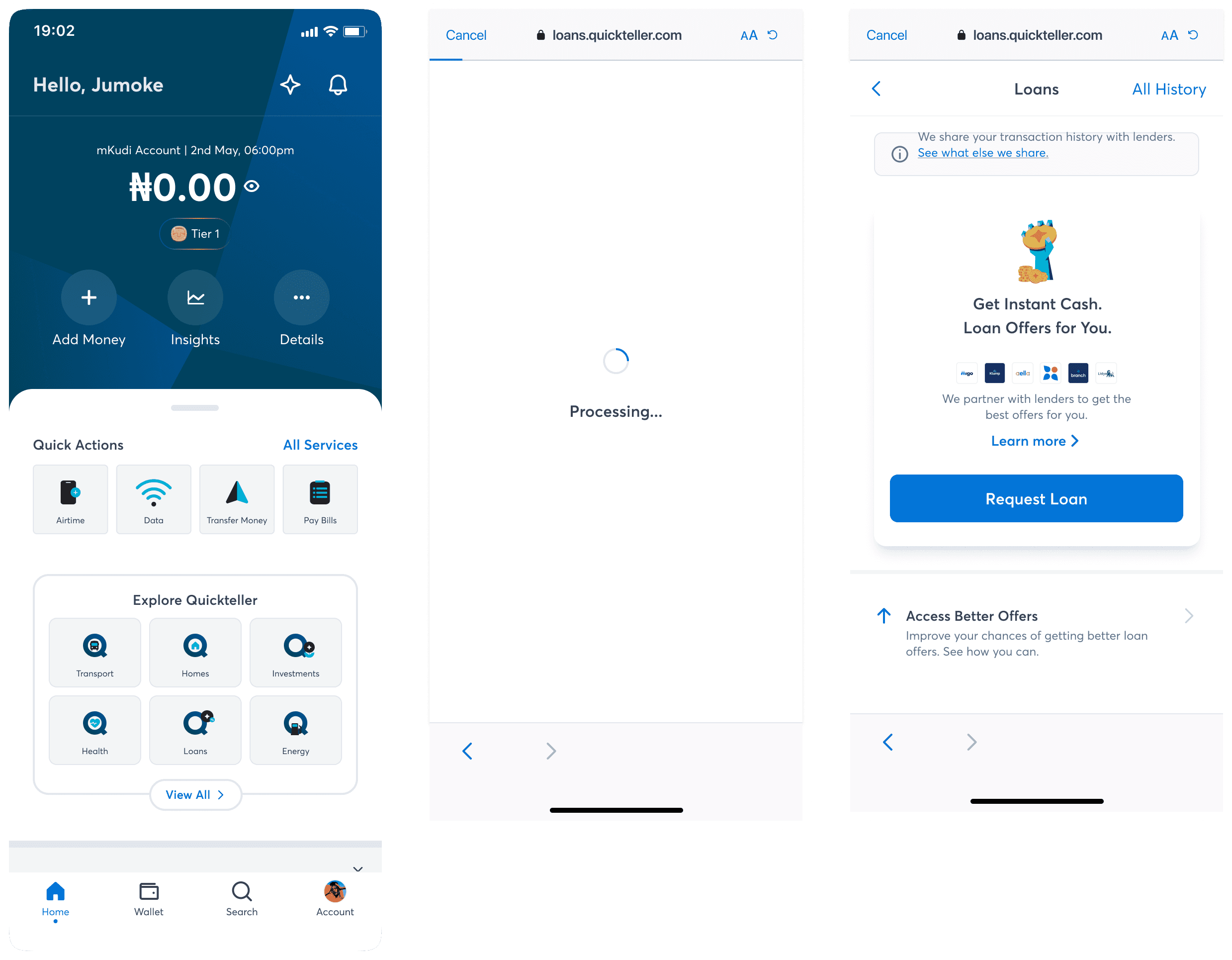
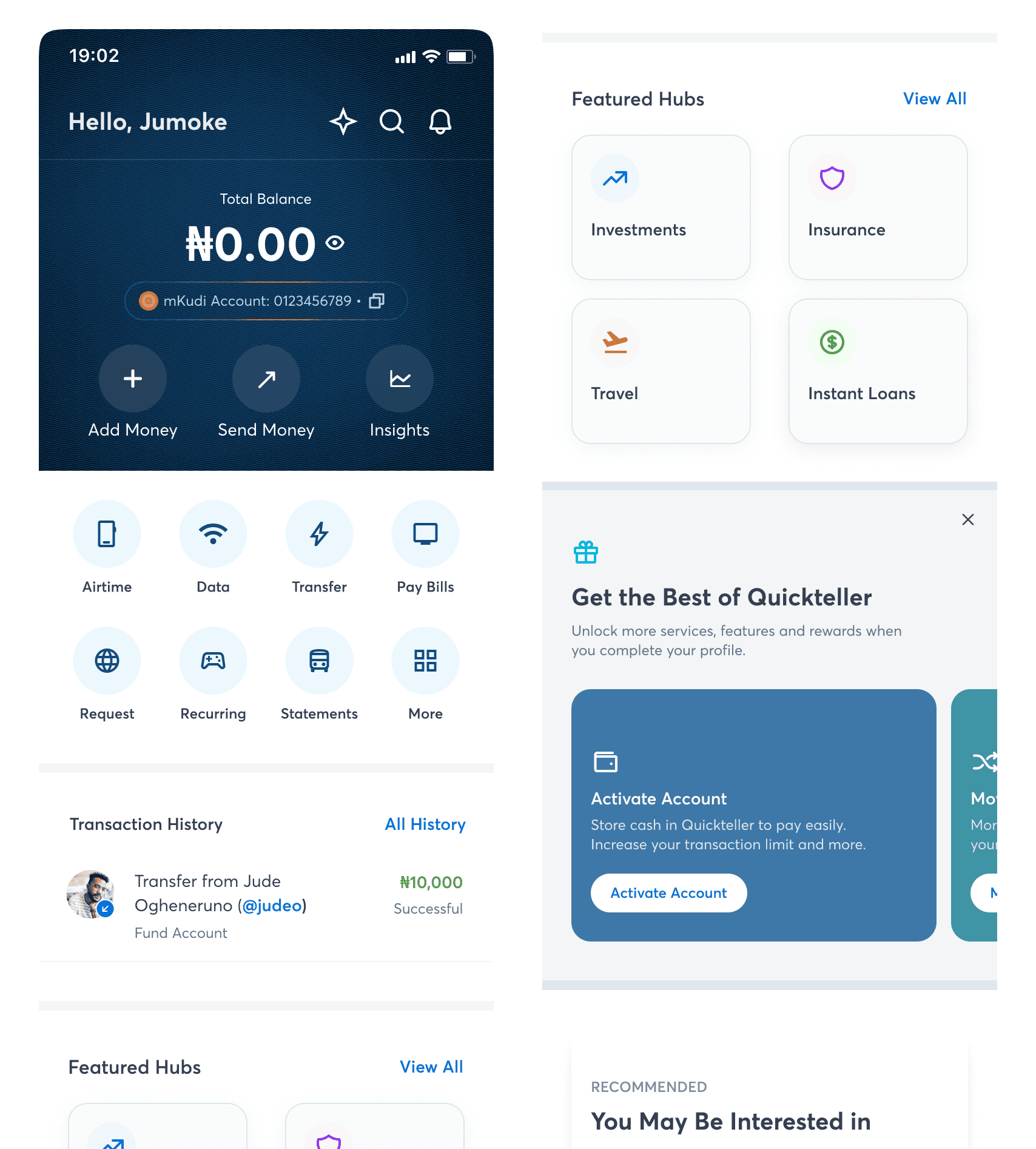
Three ways to fix it: build every new experience natively into the app, hand more of it off to embedded SDKs, or cut back to a single hub, transactions at the center, everything else tucked underneath it instead of sitting beside it as its own destination.
We chose the hub.
Before, the homepage was a wall of buttons, one for every feature the business had ever shipped. After, it was one thing: pay, transfer, send. Investments, loans, USSD access, all of it still there, just one layer down, in its place, instead of competing for the same space.
By the time I arrived, Quickteller was straining again.
Every quarter. More sub-products. More places to look.
Someone had flagged it before. The business hadn't acted.
It was brought up, and then we reached a consensus on fixing this problem with the business.
Three ways to fix it: build every new experience natively into the app, hand more of it off to embedded SDKs, or cut back to a single hub, transactions at the center, everything else tucked underneath it instead of sitting beside it as its own destination.
We chose the hub.
Before, the homepage was a wall of buttons, one for every feature the business had ever shipped. After, it was one thing: pay, transfer, send. Investments, loans, USSD access, all of it still there, just one layer down, in its place, instead of competing for the same space.

Approach 1
Approach 1
Approach 1
Approach 2
Approach 2
Approach 2

Approach 3
Approach 3
Approach 3
Final View
Final View
Quickteller is for transactions. Everything else earns its place around that center.
The hub wasn't the only thing moving.
Security. Compliance. Personalization. Recurring payments. Beneficiaries. Rewards.
Quickteller is for transactions. Everything else earns its place around that center.
The hub wasn't the only thing moving.
Security. Compliance. Personalization. Recurring payments. Beneficiaries. Rewards.
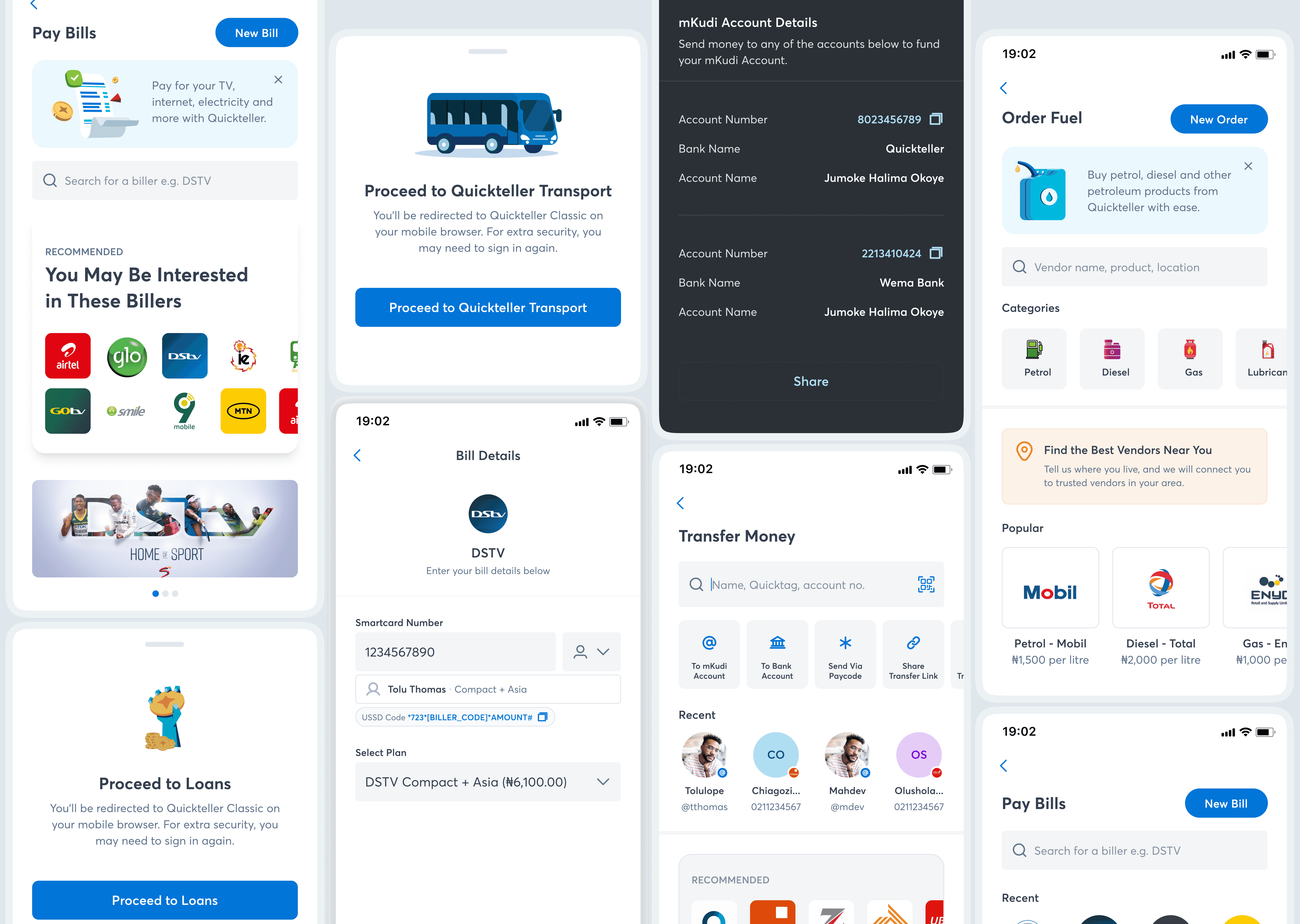


A dozen efforts, running at once. One product, staying whole while it rebuilt itself in pieces.
Six PMs. Three platforms. One system. The goal was coherence, so that no matter where a user touched Quickteller, it felt like one thing.
A dozen efforts, running at once. One product, staying whole while it rebuilt itself in pieces.
Six PMs. Three platforms. One system. The goal was coherence, so that no matter where a user touched Quickteller, it felt like one thing.
Testing What We Built
Testing What We Built
Directing a team isn't the same as knowing the product actually works. So I ran a usability test on the one thing every user eventually touches: bill payments.
Fifteen people. Six real tasks: pay an electricity bill, pay a waste bill, buy airtime, repay a loan, top up an investment, pay for cable TV.
Electricity worked. People opened the app, found the flow, and paid, without help, without hesitating.
The rest didn't. We found fourteen issues in total.
Investment, loan repayment, and the waste bill all failed the same way. None of them had a clear entry point. Users had to guess where the feature even was, and most gave up before finding it. Investment was the worst of the three: nobody in the test completed it.
That confirmed something we'd already decided. We were blunt about it in the write-up: investment needed to stand on its own, not live buried inside bill payments. That's exactly the shift the hub redesign was built to make.
The rest of what we found were narrower, and each one told us who actually owned the fix. Checkout crashing mid-payment wasn't a design problem, it belonged to Dev alone. A phone-number field that showed saved beneficiaries instead of open contacts wasn't Dev's to fix alone, it belonged to Design and Product together. Users not understanding what a "postpaid plan" even meant needed all three of us in the room, because it touched wording, flow, and the data behind it.
Fourteen issues, in total. Not one of them belonged to Design alone.
Directing a team isn't the same as knowing the product actually works. So I ran a usability test on the one thing every user eventually touches: bill payments.
Fifteen people. Six real tasks: pay an electricity bill, pay a waste bill, buy airtime, repay a loan, top up an investment, pay for cable TV.
Electricity worked. People opened the app, found the flow, and paid, without help, without hesitating.
The rest didn't. We found fourteen issues in total.
Investment, loan repayment, and the waste bill all failed the same way. None of them had a clear entry point. Users had to guess where the feature even was, and most gave up before finding it. Investment was the worst of the three: nobody in the test completed it.
That confirmed something we'd already decided. We were blunt about it in the write-up: investment needed to stand on its own, not live buried inside bill payments. That's exactly the shift the hub redesign was built to make.
The rest of what we found were narrower, and each one told us who actually owned the fix. Checkout crashing mid-payment wasn't a design problem, it belonged to Dev alone. A phone-number field that showed saved beneficiaries instead of open contacts wasn't Dev's to fix alone, it belonged to Design and Product together. Users not understanding what a "postpaid plan" even meant needed all three of us in the room, because it touched wording, flow, and the data behind it.
Fourteen issues, in total. Not one of them belonged to Design alone.


What This Taught Me
What This Taught Me

I didn't start Quickteller Rebirth. Years of decisions were already in place before I arrived.
What I did: lead the next chapter. Reopen an issue about bloat the business had set aside. Direct a team across a dozen simultaneous rebuilds. Push the team to test what we'd built, instead of assuming it worked.
This project changed how I lead. How I think about scale, about research, about what it means to advocate for a user when business pressure pulls the other way.
Most real products don't start at zero. This one taught me how to lead in the middle of someone else's beginning, and leave it better than I found it.
I didn't start Quickteller Rebirth. Years of decisions were already in place before I arrived.
What I did: lead the next chapter. Reopen an issue about bloat the business had set aside. Direct a team across a dozen simultaneous rebuilds. Push the team to test what we'd built, instead of assuming it worked.
This project changed how I lead. How I think about scale, about research, about what it means to advocate for a user when business pressure pulls the other way.
Most real products don't start at zero. This one taught me how to lead in the middle of someone else's beginning, and leave it better than I found it.